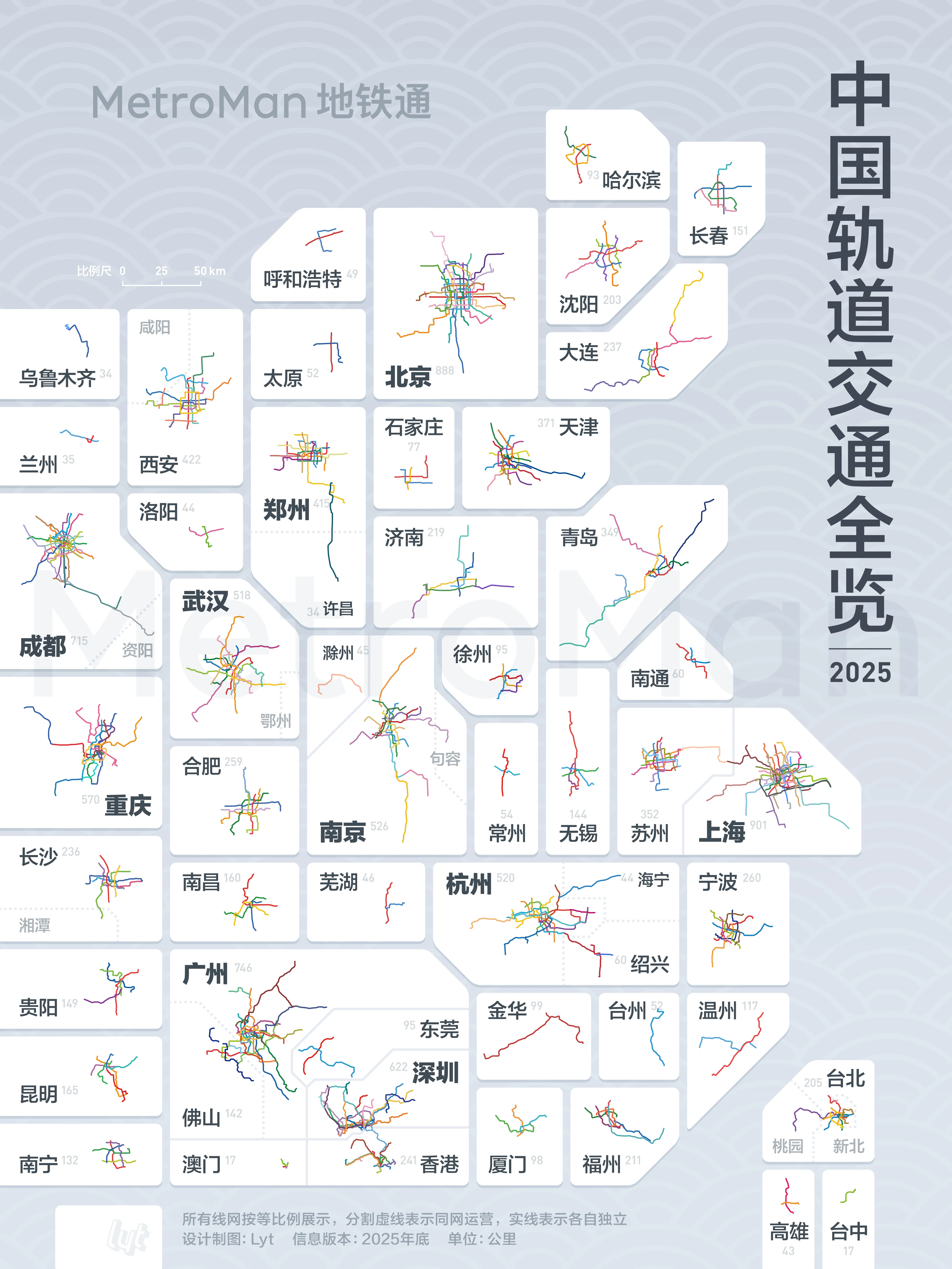
The layout of urban construction profoundly influences the planning and direction of rail transit lines. To make them easier for passengers to read, conventional metro maps usually employ schematic designs. However, MetroMan presents the real geographic network of metros across China through a single map. At a 1:1 scale, one can intuitively compare the network density of different cities.
Some cities focus their development on the central urban area, while others completed long-distance lines connecting peripheral districts and counties early on. In recent years, the rail transit systems of several metropolitan areas have become interconnected. In the future, even more cities will be linked through rail transit.
Major metropolitan areas that have already formed a significant scale or are currently under construction include:
- Greater Bay Area (GBA): Guangzhou and Foshan have achieved integrated network operations. In the future, the network will further extend to Dongguan, Shenzhen, Huizhou, Zhongshan, Zhuhai, and other cities.
- Yangtze River Delta: Shanghai and Suzhou are connected via two Line 11 routes with a transfer at Kunshan. The Nanjing Metropolitan Area has connected to Jurong in Zhenjiang, with future links to Ma'anshan, Chuzhou, and Yangzhou. The Hangzhou Metropolitan Area is connected to Shaoxing and Haining in Jiaxing, and will link to Deqing in Huzhou this year.
- Taipei Metropolitan Area: Covers Taipei, New Taipei, and Taoyuan, with a future extension to Keelung.
- Other Key Metropolitan Areas: Xi'an and Xianyang are advancing their integration; the Beijing Metropolitan Area (Langfang, Xiong'an) is about to achieve network connectivity; the Chengdu Metropolitan Area (Ziyang, Deyang, Meishan, etc.) and the Xiamen Metropolitan Area (Zhangzhou, Quanzhou) are also accelerating their construction.